| San
Pedro de Zacapa appeared in the official Honduran political
land divisions as a municipality in 1889. The name of
the municipality recognizes two very important elements
of Honduras’ cultural history: “San Pedro”
to honor the Christian Apostel Peter, due to the Spanish
Catholic influence; and “Zacapa” a word
of Mayan origen that means “water over the grass.”
Each
29th of June, Zacapa celebrates the anniversay of its
founding with its Feria Patronal,
an week-long event that includes various civic, cultural
and social activities.
Before
being recognized as its own municipality, Zacapa was
initially known as “La Adelita” (“The
Little Village”) and belonged to the municipality
of San Antonio de Shushuitepeque (which now forms part
of Zacapa). The original settlement consisted mainly
of small families, but after the majority of its inhabitants
died of yellow fever, the remaining inhabitants moved
around to various sites before arriving to the town’s
current location. |
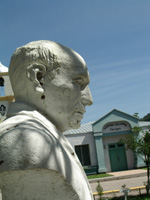 Estatua
de Profesor Rafael Bardales Bueso en el Parque
Central de Zacapa
Estatua
de Profesor Rafael Bardales Bueso en el Parque
Central de Zacapa |
|
|
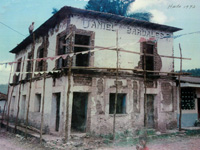
Cafe Don Daniel 1992 durante la restauracion de este edificio
historico.
|
The
current population of the municipality is approximately 8,300.
While the main ethnic origens are mestizo, there is also a
strong Lencan population in several of the villages. The municipal
patrimonies are agriculture, livestock,
fishing and artesan works, among
others. Zacapa also has many beautiful natural attractions:
Azacualpa’s Hot Springs Cave, the La Boquita (“Little
Mouth”) waterfall, the Salto del Río Canjel (“Dive
of the Canjel River), and abundant pine forests with rustic
trails passing through them. Part of Zacapa also lies on the
famous Lago
de Yojoa (Lake Yojoa), where one can observe many varieties
of endemic birds, go for a ride in a small chartered boat,
enjoy some delicious fried fish, or just take in the tranquil
views that nature provides. |