Infrastructure
Like
almost most of the towns of Honduras, San Pedro de Zacapa
has had few possibilities of being developed although, in
the last few years and specifically in the near future, enormous
changes have taken place that have vastly improved the infrastructure.
The schools of the Municipality now number sixteen. There
are five kindergartens, four health centers and five community
centers.
 |
Aside
from the main road that bisects the municipality, the
access routes between communities’ villages are
poor dirt roads but they allow traffic to access over
85% the municipal territory. The municipality is connected
to the trans national highway by an 18 kilometers section
of tarmac covered road. The paving of the 2.7 kilometers
of road leading down into the urban center is due to
begin soon. Seventy percent of the urban center was
paved with beautiful colonial-style cobblestones in
2003.
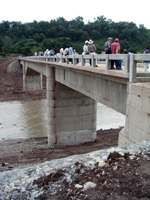
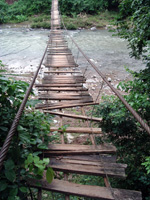
Zacapa’s myriad roads cross many rivers and streams
among which are the bridges of the Sunzucuapa River,
the Caranola River, the Zacapa River, the Jaitique River
in Azacualpa, the Ulúa in AGua Caliente and the
fording of the Guajiniquil river.
|
The electric
lines are outdated and in some cases not functional which
makes it difficult for small textile factories or factories
with industrial equipment to maintain their operations. Although
there are occasional outages, most houses in the urban ceneter
maintain continual electrical power.
Most
of these houses are made of concrete whereas in the
rural areas as many as 90% of dwellings and buildings
are constructed with mud, sticks and other traditional
materials most commonly topped with a straw roof.
Around
half of the communities now have electricity in some
form, 90% have running potable water but only three
of 16 villages have any kind of community phone service.
Private phones are not available although some people
carry cellular phones. In the urban center there is
Internet service via satellite, a post office and a
HonduTel office with teleggraph service and phones.
|
 |
|