Community
Centers for Knowledge & Communication- CCCC
 |
These
centers are a nationwide project of the Honduran government
directed by local communities through committees known
as CMCTs. Their purpose is to offer access to a range
of services as outlined below for each community.
What
are Community Centers for Communication and Knowledge(CCCC)?
CCCC’s are place where children, youth and adults
have the opportunity to improve their knowledge. The
centers open opportunities for development providing
technological communication and the processing that
allows the evaluation of different areas, such as health,
education, culture and small businesses. This will strengthen
the increase productivity in the community.
|
How
were communities selected for CCCCs?
There was a pre selected of 100 communities chosen by the strength
of the social commitment of the local government and the poverty
index of Honduras. A committee analyzed the 200 solicitudes
using a selection criteria defined in the project documents,
time variables, space and available resources. Using these criteria
the 100 locations were classified in order to be beneficiaries
of the project.
How
does one start a CCCC?
There are four stages to starting a CCCC which is part of a
single process. The intent is to have cohesion and order within
the groups involved in the project to insure efficiency and
effectiveness. Each project will have its own specialty, characteristics
and the individuality of the community it is benefiting.
How do CCCC function?
The CCCC projects are managed by CMCT (Municipal Committee of
Knowledge and Technology) in which the Communications and Knowlege
Community Center (CCCC) also functions, a project which is financed
by the funds of the IDB (International Development Bank through
COHCIT (Concejo Hondureño de Ciencia y Tecnología)
and the central government.
How
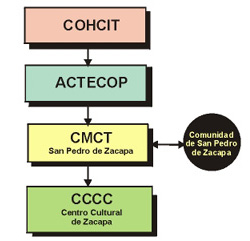
does the CMCT and the Zacapa community fit in with
ACTECOP, COHCIT
and theCentro Cultural de
Zacapa?
The governmental program (known as
COHCIT) gives funds to a program called ACTECOP
in order to fund Cultural Centers in the poorest
areas in Honduras. These center must become self
sustainable in six months time. The community
of San Pedro de Zacapa elected a representative
committee from the general assembly. This committee
meets on a weekly basis to provide supervision
to the center and plan strategies and events.
The center employs an administrator, a librarian
and an assistant. Their goal is to ensure that
the center is self sustainable and that it provides
social and human development to the municipality.
|
 |
|
The goal is to
create sustainable centers and programs, self-managed by the
community and with emphasis on human and social development
in the fields of knowledge and communication.
 
|